Jun 23, 2026
The sensor stack of a health companion robot, layer by layer
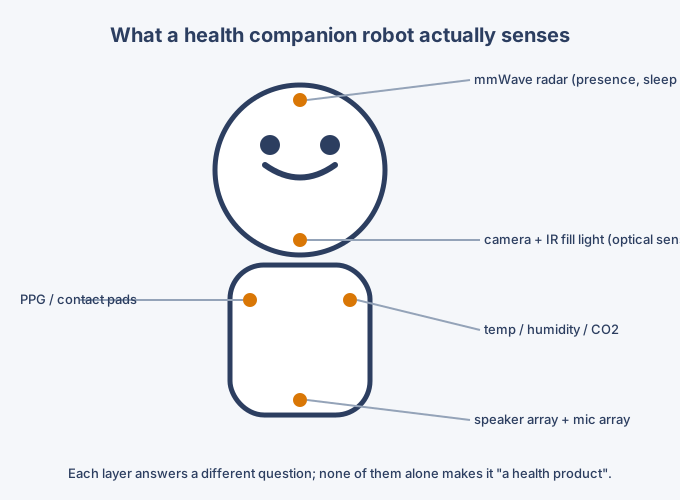
“Health companion robot” sounds like one feature, but it is a stack of independent sensing layers, each answering a different question. Understanding the layers is what separates a credible product plan from a spec-sheet wish list.
Layer 1: presence and rhythm
Millimetre-wave radar answers “is someone here, and is their routine normal” without any camera. It works in the dark, sees through blankets, and carries no image-privacy baggage. For sleep-adjacent products it is the first sensor we recommend.
Layer 2: optical
A camera adds what radar cannot: posture, face presence, fall posture, visual context. It demands lighting (an IR fill light for night), and it demands a privacy story — physical shutter, local-only processing, clear indicators. A camera without that story is a support-ticket generator.
Layer 3: contact
PPG and contact electrode pads measure signals the other layers cannot: pulse rate, and with proper electrode geometry, bioimpedance estimates. Contact sensors live or die on mechanical placement — where hands naturally rest — more than on electronics.
Layer 4: environment
Temperature, humidity, CO2 and PM2.5 turn the device from a companion into a room-aware product. These sensors are cheap; the cost is in calibration drift and in how the product talks about air quality without becoming an alarmist.
What to include first
For a first model: radar + environment + microphone/speaker. Contact pads and camera belong in a version where the mechanical placement and privacy story have been validated. A robot that nails presence, voice and air feels competent; one that promises vitals and delivers drift feels broken.